Before the Lock-In: Why Spatial Computing Needs Open Standards Now
Ali C. Hantal presented at the New Tech Forum in Athens, organized by p-NET Emerging Networks & Vertical Applications. Below is a summary of his argument, along with live updates on the standardization efforts he’s been driving.XR Masters CEO Ali C. Hantal joined an esteemed panel of industry leaders, academics, and global institutions at Techritory 2025, one of Europe’s foremost technology conferences, to discuss the Future of AI Use Cases. The event, held in Riga, Latvia, brought together forward-thinking voices shaping the next generation of artificial intelligence.
Last month, our CEO Ali C. Hantal took the stage in Athens at the New Tech Forum, organized by p-NET Emerging Networks & Vertical Applications. Ali serves as Co-President at Open AR Cloud Association, Adoption Officer for the GeoPose SWG at OGC, and is one of the leaders behind the MSF Forum Lab Initiative. His talk focused on Spatial AI, XR standardization, and a fragmentation problem the industry isn’t talking about loudly enough.
Here’s the argument he made.
From Mobile AR to AI Glasses: The Long Road to Adoption
Mobile AR proved the technology, but it wasn’t ergonomic, battery life was a problem, and discovery was nearly impossible. Video passthrough headsets pushed further, but remained bulky, expensive, and isolating. The Apple Vision Pro is extraordinary engineering. It is not a consumer product.
The real shift is happening through audio-first AI glasses.
Meta’s partnership with EssilorLuxottica sold over 7 million units in 2025, more than triple the previous two years combined. Google launched Android XR. Samsung, Xiaomi, Amazon, Rokid, and XREAL are shipping or have announced products. The category is real, and it is moving fast.
The Fragmentation Problem No One Wants to Talk About
As this ecosystem explodes, it’s fragmenting, exactly the way mobile did before the App Store. Every museum, every retailer, every city is building its own AR experience. None of them talk to each other.
We’ve seen this movie before.
The App Store ended that fragmentation, and replaced it with hegemony. Two companies. Their rules. Their cut. Their veto.
That’s why Ali has been contributing to interoperability efforts since 2018, across the Open Geospatial Consortium, Open AR Cloud, and the Metaverse Standards Forum. The goal is to build the open infrastructure layer before the platform lock-in becomes permanent.
Where Things Stand: Live Updates from the Standards World
GeoPose (OGC): A universal addressing system for the physical world. GeoPose is a fully ratified OGC standard. Any device, any vendor — content appears exactly where it’s meant to be.
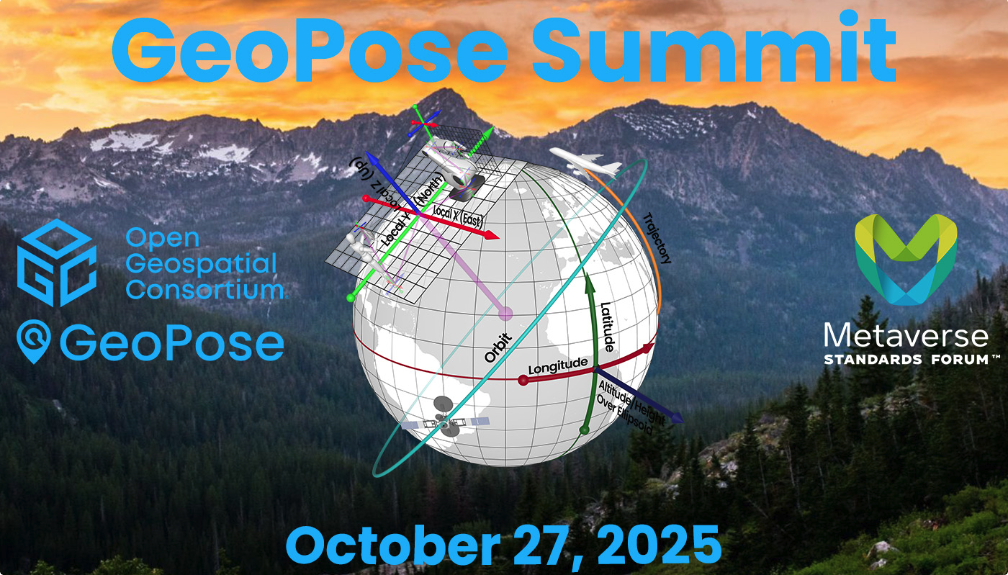
GeoPose Summit 2025 (MSF, OGC, OARC): Key stakeholders gathered in Denver and aligned on adoption roadmap and next steps.
OMBI (MSF): The Open Metaverse Browser Initiative applies the browser model to physical space. No separate app per service, just open, navigable spatial experiences.
OpenVPS (OARC): Vendor-neutral visual positioning infrastructure, so any AR-enabled device can localize itself without being tied to a single provider’s stack.
Spatial DDS (OARC): Real-time data distribution for live, multi-user spatial experiences. This is the interoperability layer that makes shared spatial computing possible.
Testbed Program (OARC) & Forum Labs Initiative (MSF): Real-world testing and validation of all of the above. Standards only matter if they work outside the whiteboard.
Why We Built MyGeoVerse
All of this is why we built MyGeoVerse, the first commercial platform implementing these open standards. Device agnostic. OS agnostic. VPS agnostic. Built to prove that open standards work in the real world, not just in whitepapers.
The physical world is becoming programmable. Who writes the code, and on whose terms, is the question we’re answering right now.
Get Involved
At Open AR Cloud, we’re actively looking for testbed partners, universities, tech centers, schools, innovation hubs, or anyone building location-based experiences on open standards.
Utilizing our platform, you can create your own persistent and shared AR experiences and publish your own mobile spatial browser app for your audience.
We are equipped to meet all of your organization’s AR and VR needs, tailoring our services to fit your specific goals and budget. Our team has a track record of success, having assisted prestigious organizations in the US and Europe in achieving their XR objectives.
Experience the full capabilities of our technology firsthand by requesting a free demo and viewing our sample use cases. Contact us today for more information.
We are excited to hear about your ideas and answer any questions you may have. Let's Talk!